
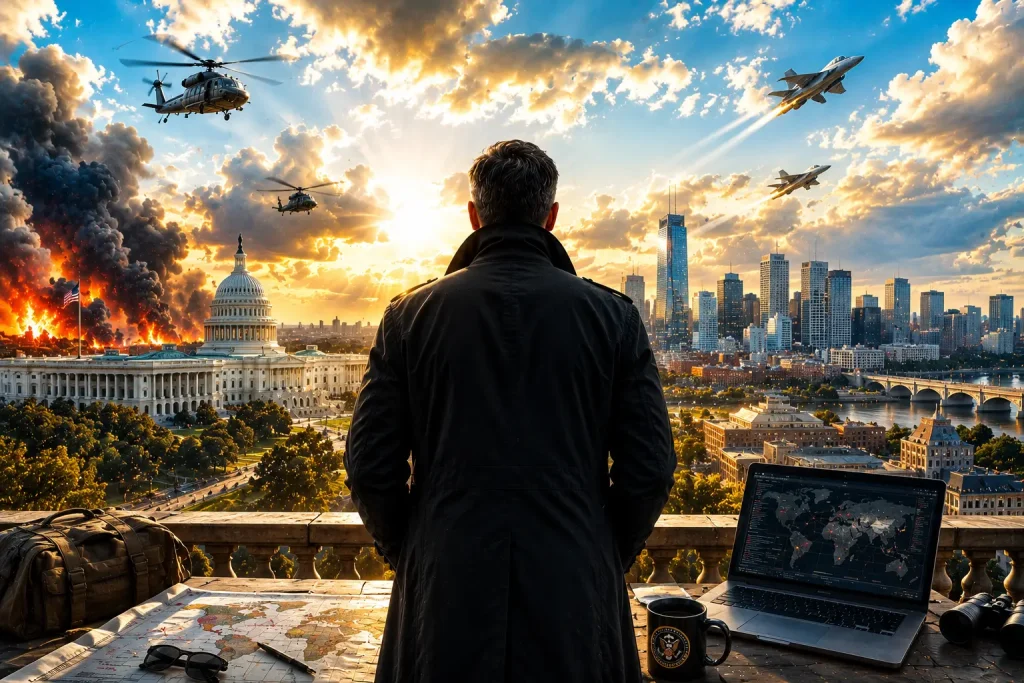
When I wrote A Time of Chaos, I wanted to take everything that began in A Time of Lies and push it further. The stakes needed to be higher, the dangers more personal, and the consequences far greater. My goal was to create a story where political instability, intelligence warfare, and global uncertainty collide in ways that feel both believable and immediate.
What fascinated me most while writing this novel was the idea of a world slowly beginning to fracture under pressure. The threats in A Time of Chaos are not isolated events hidden in the shadows. They spread across governments, intelligence agencies, military operations, and political systems already struggling to maintain control. Every decision creates consequences that extend far beyond a single mission or a single country.
At the center of that storm is Brian McCarty.
From the beginning of the series, I never wanted Brian to be an invincible action hero. I wanted him to feel like a real person carrying real burdens. He is loyal, determined, disciplined, and capable, but he is also forced to make difficult decisions while dealing with enormous pressure and responsibility. To me, that realism creates far more tension than any flawless protagonist ever could.
One of the themes I wanted readers to experience throughout A Time of Chaos is uncertainty. The danger no longer comes from one source. Political leaders have hidden motives. Intelligence agencies pursue conflicting objectives. Alliances begin to weaken. Trust becomes fragile. Even moments that appear stable can quickly unravel. I wanted readers to feel as though chaos was always waiting just beneath the surface.
As a writer, I’ve always been drawn to geopolitical suspense because it allows fiction to explore fears that already exist in the real world. The conflicts within A Time of Chaos are inspired by concerns we see every day—international instability, political manipulation, intelligence warfare, and military escalation. By grounding the story in those realities, I hoped to create a thriller that feels relevant rather than exaggerated.
Pacing was also extremely important to me. I wanted the novel to balance political strategy, espionage, emotional conflict, military pressure, and psychological tension without losing momentum. Every chapter needed to feel connected to something larger unfolding behind the scenes. Readers should constantly sense that events are moving toward a breaking point, even when the full picture remains hidden.
What means the most to me, however, is the emotional weight beneath the action. While A Time of Chaos contains intelligence operations, political intrigue, and international conflict, it is ultimately a story about loyalty, sacrifice, survival, and responsibility. Brian McCarty is not simply trying to complete a mission. He is fighting to preserve his humanity while navigating systems that often value power more than people.
Readers who enjoy the works of Tom Clancy, Vince Flynn, Brad Thor, and Daniel Silva will likely recognize the attention to detail and realism that influenced my approach to storytelling. At the same time, I wanted A Time of Chaos to establish its own identity through atmosphere, emotional intensity, and its focus on the personal cost of global conflict.
For me, this novel is more than a political thriller.
It is a story about what happens when the institutions designed to maintain order begin collapsing under the weight of ambition, deception, and fear. It is about survival in a world where trust disappears faster than truth. Most importantly, it is about one man standing in the middle of the storm while the world around him spirals into chaos.